
Mountain Biking in Brașov and the Romanian Carpathians: A 2026 Rider’s Guide
By Victor Cristescu | Updated 10 August 2026
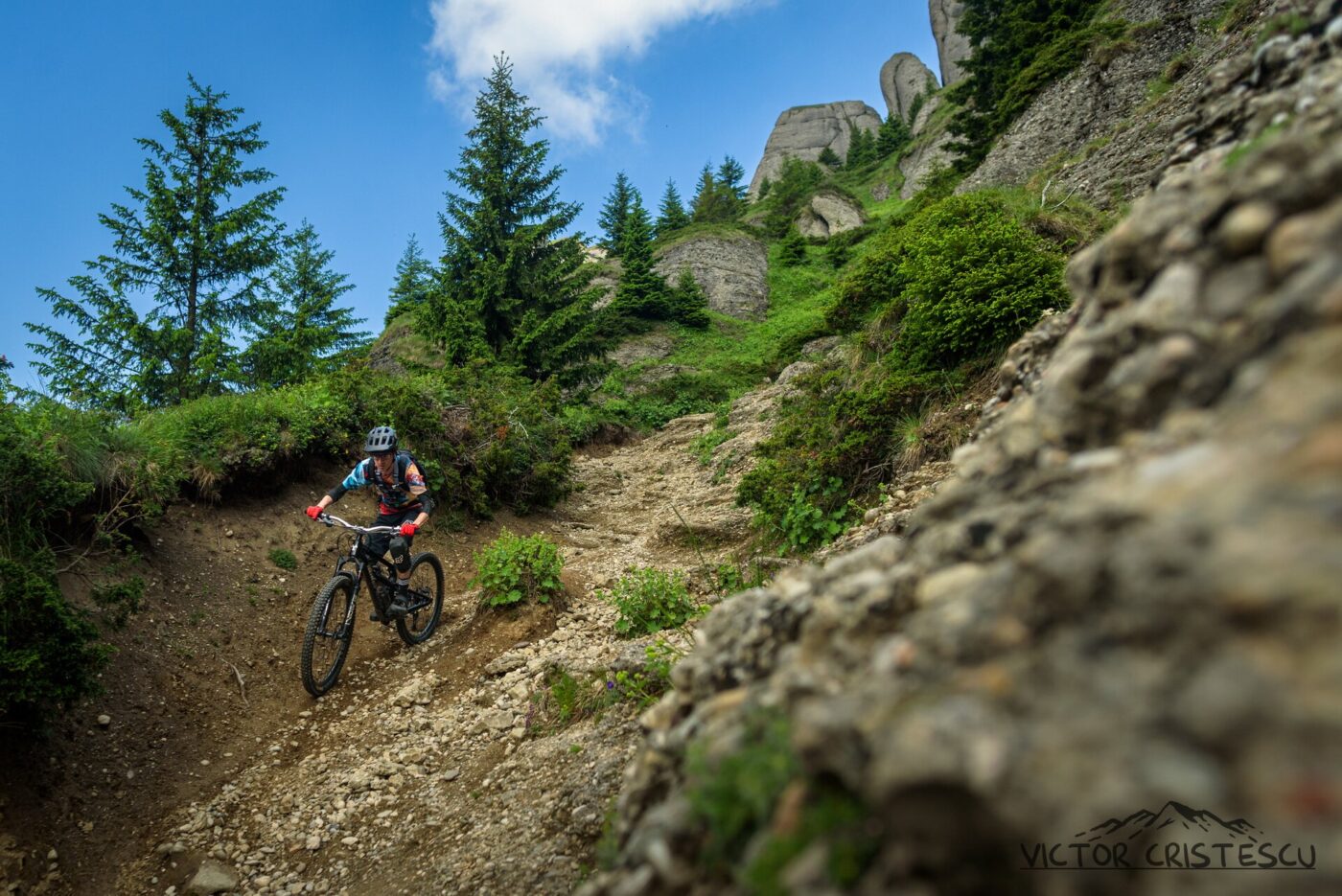
I learned these mountains on foot before I learned them on a bike. As a child I walked the trails around Brașov with my parents, and somewhere along the way the Făgăraș became the mountains of my heart. The bike came later, almost by accident, in 2014. What had been a slow love became a faster one. With the camera, both speeds belong together: the long gaze, the quick reflex.
This is a guide to mountain biking in Brașov and the wider Romanian Carpathians, the way I ride them and the way I shoot them, written for 2026. What’s worth knowing if you’re coming to ride.
For me, capturing the action from behind the bars demands a state of pure, razor-sharp focus, a way to stay anchored in the moment and enter that quiet state of flow that only unfolds when you stop chasing it. This became even more apparent during Up to Postăvaru 2022, a multi-disciplinary event where eMTB, trail running, and downhill converge. That year, the eMTB route included ‘Jackie’, a trail I personally helped build. Documenting a race on a trail you know by heart is a huge asset; knowing every root and turn allows you to anticipate exactly where the racers will push their limits. I’ve tried racing myself, but honestly, I feel most at home leaving the start line ahead of the pack, embracing my creative side without sacrificing my thirst for speed.
Why ride from Brașov
Six massifs sit inside a sixty-kilometre radius of the city. Postăvaru rises directly above town. Bucegi to the south, Piatra Craiului to the west, the northern ramparts of Făgăraș, Ciucaș to the east, and the Bran-Rucăr corridor that ties them together. Each one rides differently. Postăvaru is mostly forest singletrack and lift-served gravity riding. Piatra Craiului is high-meadow karst with a 25-kilometre limestone wall as backdrop. Bucegi is alpine plateau, exposed and serious. Făgăraș is long days and big climbs, the range I keep returning to.
What surrounds the riding is a living, working mountain landscape that is also genuinely wild. Sheep transhumance still runs from April through November on the same routes it has for centuries. Foresters and Romsilva crews share every accessible road. At the same time, the bike scene here is young and growing: dedicated trail builders and new bike parks are starting to flourish (examples: Brava Park, Cheile Grădiştei bike park, Vatra Dornei bike park). This is not a brochure-empty wilderness, and it is not a tamed, fenced playground either. The “What you’ve heard” section near the end of this guide comes back to that distinction, because it is one of the main reasons riders from Germany, Czechia, Poland and Austria come here in the first place.
The infrastructure has changed. Brașov-Ghimbav airport opened in June 2023, and as of 2026 it carries roughly twelve destinations across seven countries. London Luton, Dortmund, Memmingen, Nuremberg, Budapest. Serious mountain terrain, a Saturday morning’s flight from much of Western Europe.
When to come, the riding season around Brașov
The season around Brașov opens itself gradually, and it is worth saying plainly that no two years are the same. Lower forest trails dry first, sometimes by mid-April. The high singletracks above 1,400 metres need until mid-May, sometimes longer. But the calendar shifts year to year: some seasons you can ride packed, frozen trails in February in genuinely good conditions, dry and grippy in the cold, while another March is buried under fresh snow. This spring, for instance, the high mountains held a lot of snow well into the season. Treat the windows below as the usual pattern, not a guarantee, and check current conditions before a high ride.
Spring opening, mid-April through May
Low-elevation rides start working before the alpine does. The earliest riding spots to dry up are in the Warthe and Stejeriş area, followed by Tâmpa, the Drumul Vechi fireroad up toward Poiana Brașov, and the lower Crucur variants. (A local detail worth knowing: Drumul Roșu climbs from Poiana Brașov up into Postăvaru and is only used once all the snow has melted, from roughly May or June; until then the ski Familial run is the usual access to Crucur, Jackie, Moto, Kermen and the other descents.) Usually, trails above the forest line stay wet and patched with snow until the second half of May.
High summer, June through August
Most terrain is rideable. June is the wettest month in Brașov, averaging around 125 millimetres of rain, and afternoon thunderstorms are normal in the high country. Bear activity peaks in July. The Bușteni cable car queues stretch into hours on summer weekends. None of this rules out summer riding, it just shapes the day: early starts, lift access (or a private shuttle) before the queues build, descents finished before the storm.
The best window, September and October
Trailforks ride logs for Postăvaru show September as the most active month of the year on the massif. Stable high pressure, lower humidity, cleaner light, fewer queues, and the alpine pastures yellowing into autumn while the forests are still green.
Personally, my riding year peaks in two distinct windows. The first two weeks of September are reserved for proper alpine adventures, like the demanding route from Poiana Neamțului up to Vârful Scara in the Făgăraș Mountains. By then, the sweltering August heat has faded, replaced by a more ‘settled’ vibe and a profound serenity that seems to wash over the landscape. The days remain long enough for big mountain loops, yet there’s a new-found calmness in the air. Then comes mid-October, the ultimate time for low alpine riding. This is when the autumn foliage reaches its crescendo, painting the trails in impossible hues. If the weather holds, the dirt is still prime and the leaf cover hasn’t yet become a puzzle. There’s a beautiful, bittersweet urgency to these rides; the knowledge that winter is closing in makes me cherish every turn as if it were the last of the season.
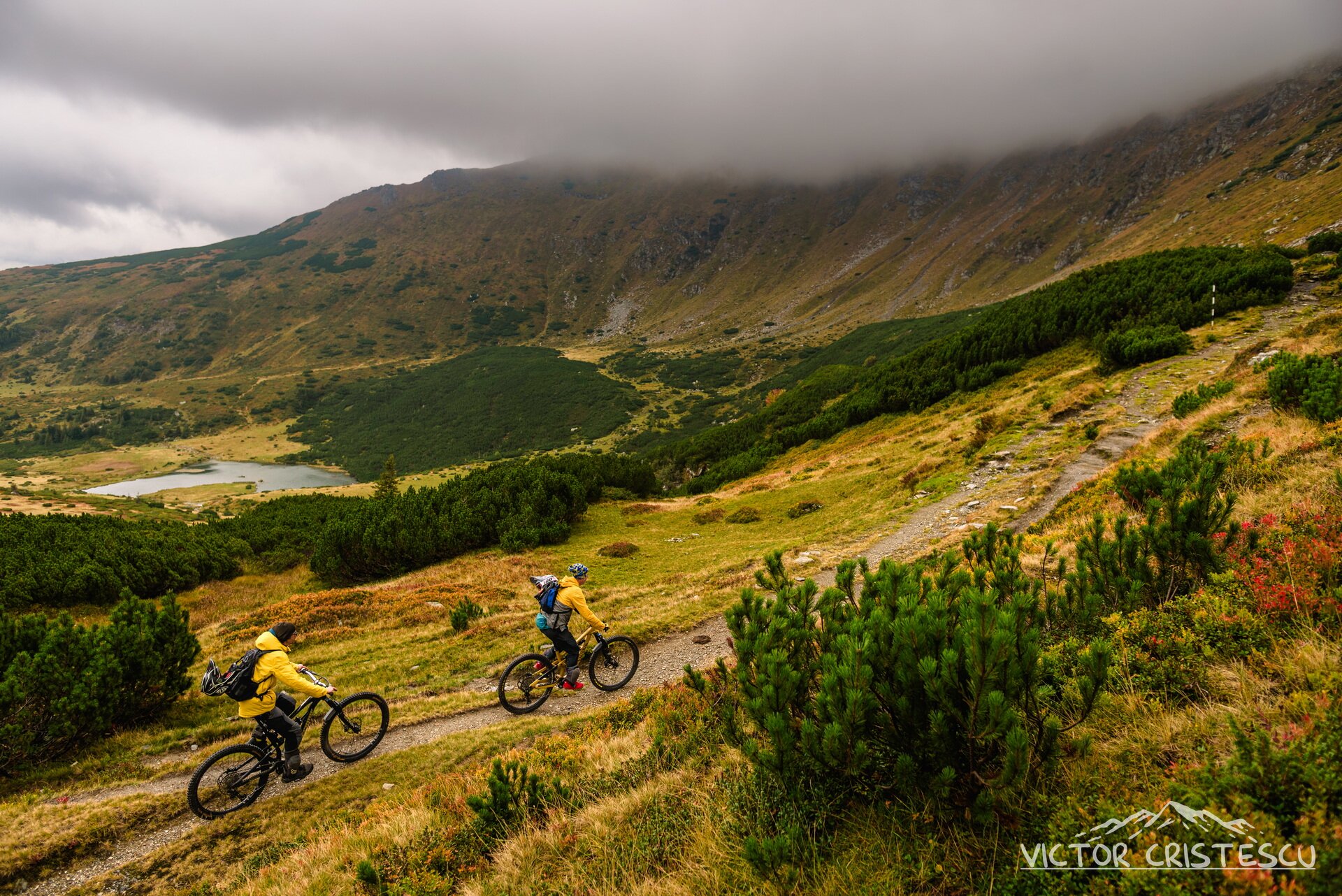
By late October the first persistent dustings arrive on the plateau, along with what I call the peak of the “leaf apocalypse”: these deciduous-forest trails get blanketed in fallen leaves, and judging hidden obstacles becomes a game of intuition rather than sight. The high trails start to lock in by early November.
The trails, riding zones around Brașov
Brașov sits at six hundred and twenty-five metres at the foot of Tâmpa. The riding zones radiate outward from there, light to heavy in commitment.
Tâmpa and Răcădău, riding from the city
Tâmpa is the small mountain you see from the Old Town, with the white “BRAȘOV” sign on its flank at nine hundred and sixty metres. The classic loop goes up the back via Răcădău or Pietrele lui Solomon (and there are other, less mainstream lines that are more e-bike friendly), climbs through forest to the saddle, and descends one of the natural or man-made lines back into the city. Roughly eighteen kilometres, four hundred and sixty metres of climbing, half a day with a coffee at the end. On an e-bike you can sprinkle some techy climbs into the mix and link more descents.
A practical detail: Brașov city bus line 20 carries bikes on a dedicated trailer up to Poiana Brașov, which opens the gravity options without a shuttle car. The city also runs a “Vinerea verde” scheme: on Fridays, public transport across the city is free for everyone, visitors included.
Postăvaru, the Bike Park and the natural lines
Postăvaru is the centrepiece. Two layers, both meaningful: the formal lift-served bike park, and the older natural singletracks that descend into the city.
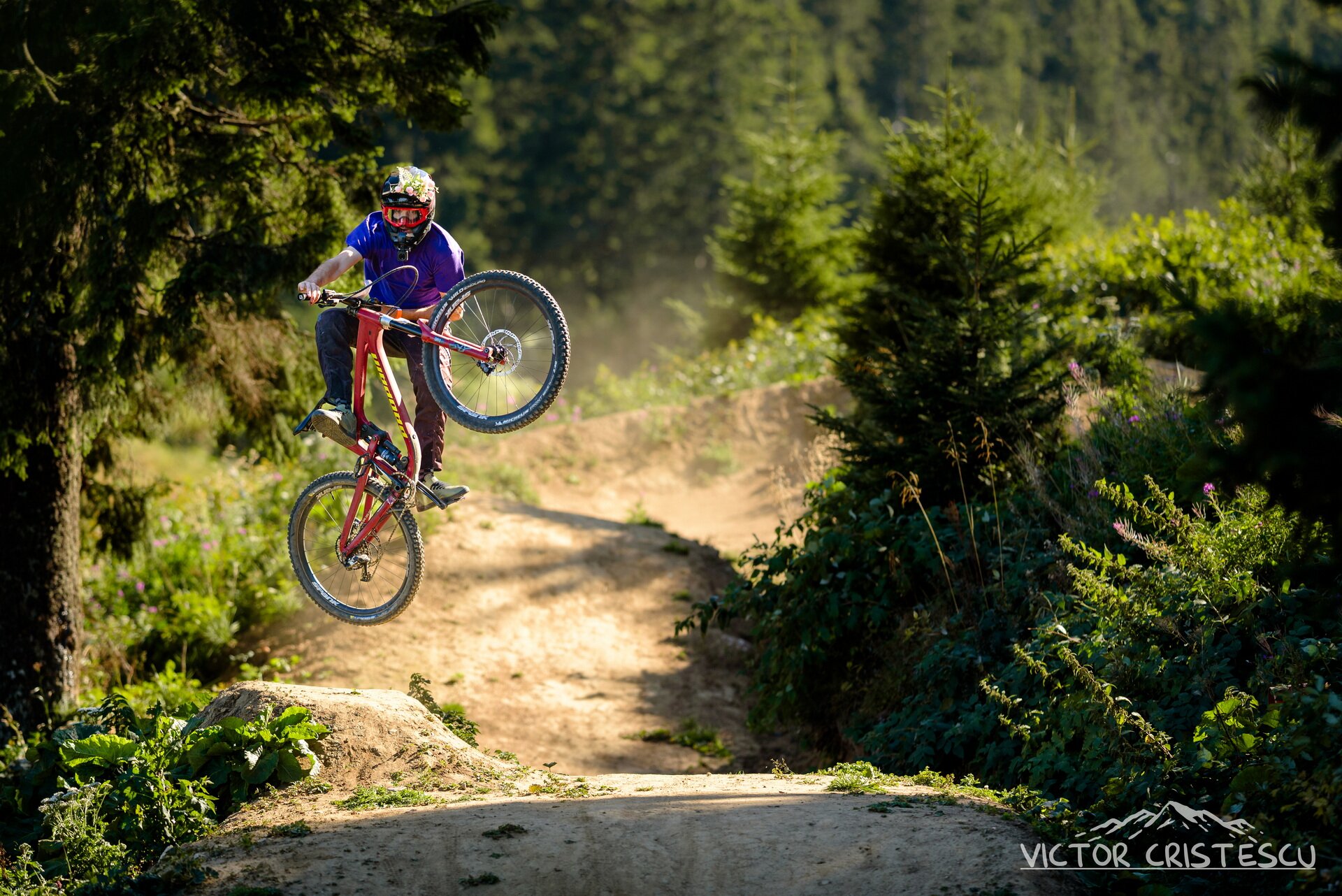
The Bike Park. Bike Park Postăvarul opened in 2020, the work of NH Bike with Brașov City Hall and trail builders Trail Bros and Elevation Trailworks. Seven lift-served gravity lines totalling around twenty kilometres. The “Monkey Business” descends from the vicinity of the Ruia artificial lake down to the Poiana Brașov base, and is used for national downhill championships: a pure DH track with some big jumps and fast open sections, plus slower, steep and technical lines in the forest. There is also an ongoing project to build a line that will descend all the way into Brașov itself; for now it is still under construction and runs only from Poiana Brașov down to Poiana Mică. Westreme, around 2.9 kilometres, is the most enduro-flavoured track, similar in character to Respawn. The Red Line carries a wooden wall ride and several drops, and was the first trail to open in Bike Park Postăvarul in 2020. As the park’s flagship flow trail, the Blue Line offers a massive 5 km descent. It starts with the beginner-friendly Forest Flow and gradually evolves as you plunge into Killy’s Back Yard, Ranger-Danger, and Techno Belly. It is an immersive experience, packed with enough berms and tabletops to keep any rider anchored in the moment until the very last metre.
Running parallel to the Blue Line is a triad of trails, CL Over, Deaktator, and Manland. While they still follow a flowline rhythm, these tracks are noticeably rougher and less polished than their blue counterpart. They are a real step up in difficulty, literally starting with a substantial step-up at the entrance of CL Over that immediately sets a more technical tone for the descent.
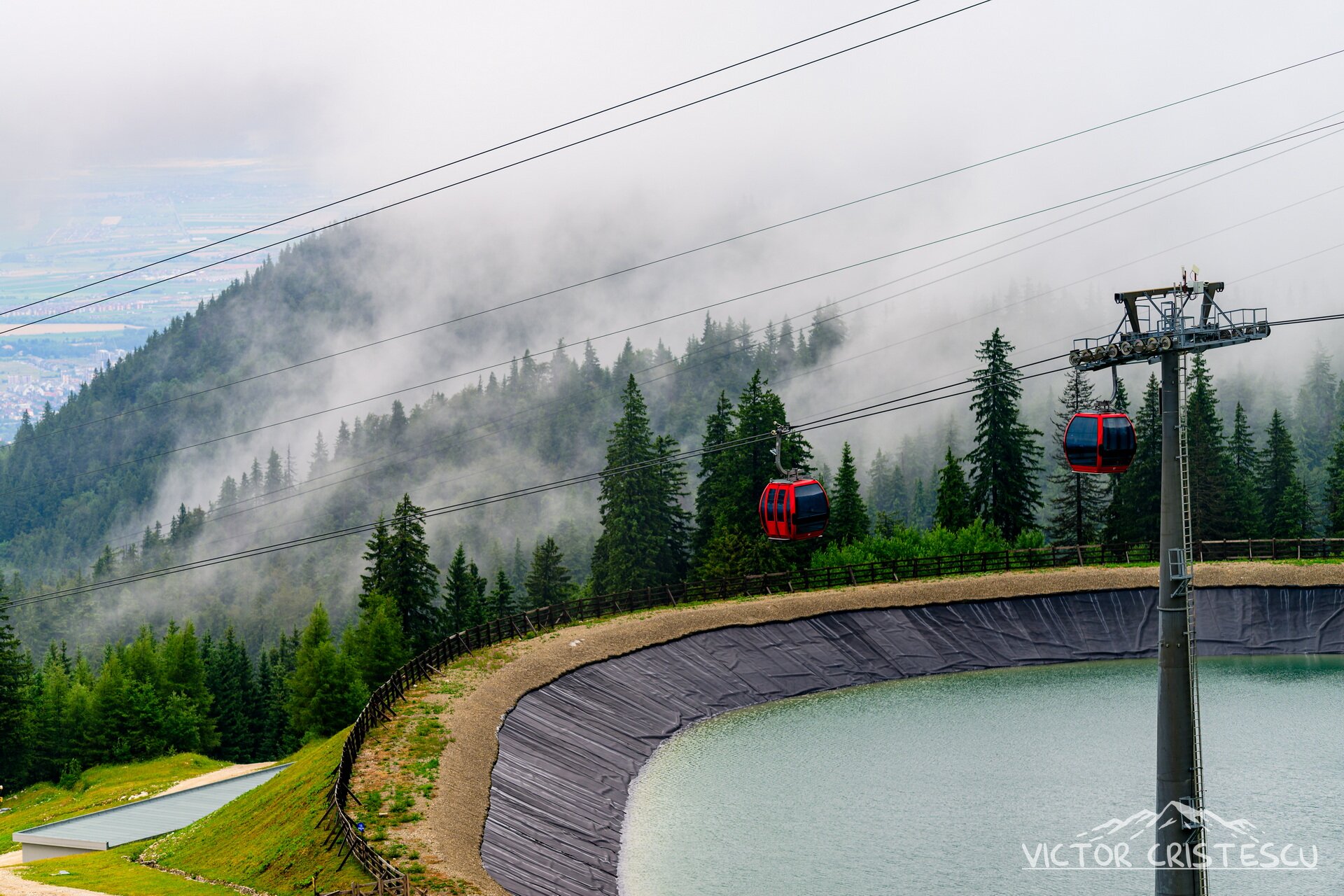
Lift access shifts through the season, so check what is actually running before you build a day around it. The Postăvarul Express gondola spent the first part of the 2026 season under maintenance and returned to service in mid-July; it carries bikes and is once again the main uplift into the park. The Kanzel cable car and the Ruia chairlift complete the picture, the Ruia serving the Respawn, Blue Line, NH-DH, Cl Over and Red Line trails, with the return along Drumul Roșu. As a general rule, do not count on any single Poiana Brașov installation running on a given summer weekday. For 2026, a single-trip rider-plus-bike ticket is 55 lei and a full-day pass 180 lei; the cable operator is Ana Teleferic.
The natural singletracks. Outside the formal park, the riding falls into three distinct categories, and the distinction matters for how you behave on them:
- Natural singletrack on marked hiking routes, shared with walkers. Here riders give way and ride with restraint.
- Purpose-built MTB trails, shaped by locals to follow the mountain’s natural flow. A dedicated playground for bikes.
- Older, unmarked trails used for generations by the people who live and work here, now shared by mountain bikers too. Many of the best descents below the bike park fall in this category: they are not signposted by any administration and exist, in practice, on Trailforks and in local knowledge.
The Yellow Triangle (Triunghi Galben) is the longest descent from Poiana Brașov to the city, around 5 km of varied terrain. It is a quintessential all-mountain experience, blending technical sections with climbs and pedally segments toward the Warthe hill. This area hosts several man-made lines such as Corona, Canal, and Frankie Valli. Higher up, branching off from Muchia Crucurului, the network shifts into an enduro character with trails like Jackie and Moto. Closer to the city, the options multiply: Bazine, which weaves man-made lines into a traditional hiking backbone; Tobogan, with three entirely distinct sections; and Păstăi, which has the most extensive series of berms found outside the official bike park. These are only a fragment of an exceptionally wide and varied network.
My personal favorites vary from year to year, but I have strong feelings for Crucur, being a classic trail on which I measured my riding progress throughout the years. It also developed a lot of new lines in the last 5 years. Also, now I ride it uphill too on my ebike and it’s a very different type of challenge which I thoroughly enjoy.
Piatra Mare, where high-alpine grit meets hidden flow
Beyond Postăvaru, Piatra Mare is a testament to ‘earn-your-turns’ riding. The journey begins with a 6 km, 900 m vertical grind up Drumul Familiar to reach the main cabin. Riders stopping at the Piatra Mare cabin should guard their gear closely: the resident donkeys are notorious for ‘auditing’ lunches or testing a backpack’s durability with a few curious chews. Unless you are ready to negotiate your meal with the local welcoming committee, keep snacks and bags out of reach.
From there, riders choose between a scenic traverse toward Susai cabin or a plunge back to the valley via descents like Poteca Țiganilor or the more hardcore Șirul Stâncilor.
Notably, Postăvaru can be linked to Piatra Mare via the HODL trail, which branches off the ‘blue stripe’ (dunga albastră), the classic Crucur route, effectively bridging the two massifs for a longer day in the saddle. As a bonus for the curious explorer, a few well-kept secrets are tucked away off the main paths.
Bușteni and the southern Bucegi, riding the plateau via cable car
The Bușteni cable car to Babele on the Bucegi plateau accepts bikes in summer but is famous for its queues. Reviews from peak season report waits of one and a half to six hours. Off-peak it works; mid-July through August on weekends, avoid it. A round-trip ticket is around seventy lei, and expect to pay noticeably more for rider plus bike than for a pedestrian. A practical alternative used by local riders and visiting groups is a private shuttle: several companies run vans or trailered vehicles that take you and the bike up to Piatra Arsă for less than the cable car ticket and without the wait (one example: tourstraveladventure.ro).
The headline ride is the “Potcoava Bucegilor”, the Bucegi Horseshoe. From Cabana Babele or Piatra Arsă after the lift up, the route traverses Vârful Omu, Bucura, Doamnele, Bătrâna and Strungile Mari along Banda Roșie, dropping to Șimon (longer and more mellow) or Moieciu de Sus (much shorter, but steeper and more technical) via Strunga Pass. It is mostly rideable for a reasonably fit rider, with an e-bike making it even more fun, with a few places too out of reach to ride. This is the long-day plateau crossing of southern Bucegi, a true all-day epic, where weather, route-finding, and bear awareness all matter, and where a guide is sensible for a first attempt.
Piatra Craiului, trail and all-mountain country
Piatra Craiului National Park has a formally marked cycling network: eleven routes totalling around 115 kilometres, with downloadable GPX from the park’s official cycling page and a tiered blue/red/black difficulty system. With one or two exceptions, these routes are oriented toward cross-country and cycle touring rather than trail or all-mountain riding, so the marked-network high point (Șaua Joaca, 1,450 m) is not really where the riding worth travelling for happens. For trail, all-mountain and enduro, read on.
The real action begins at Fântâna lui Botorog. Crossing the towering limestone walls of Prăpăstiile Zărneștiului, riders climb to Curmătura Cabin for its famous apple pie with a fortune message. The Yellow Dot serves as a diverse warm-up, blending high-speed sections, tight forest singletracks, and stream crossings. After a second climb, the Yellow Stripe offers 4.5 km of technical terrain requiring precise bike control, with stunning vistas at Poiana Zănoaga. To finish, the Poteca Piticilor singletrack in Măgura village acts as a flowy “dessert” after the main effort.
For a long e-bike day, a “lunch and charge” at Plaiu Foii is the perfect mid-point. From here, a demanding climb on the Blue Stripe leads toward Vârful Tămașul Mare, the high point that matters for the trail rider here. Mostly a hike-a-bike for traditionalists, e-bikers can ride around 90% of the ascent, enjoying views of Marele Grohotiș and Pecineagu Lake. The payoff is a steep, off-camber descent on the Yellow Stripe, packed with switchbacks and rock gardens for those who thrive on technical terrain. All routes are available for navigation on Trailforks.
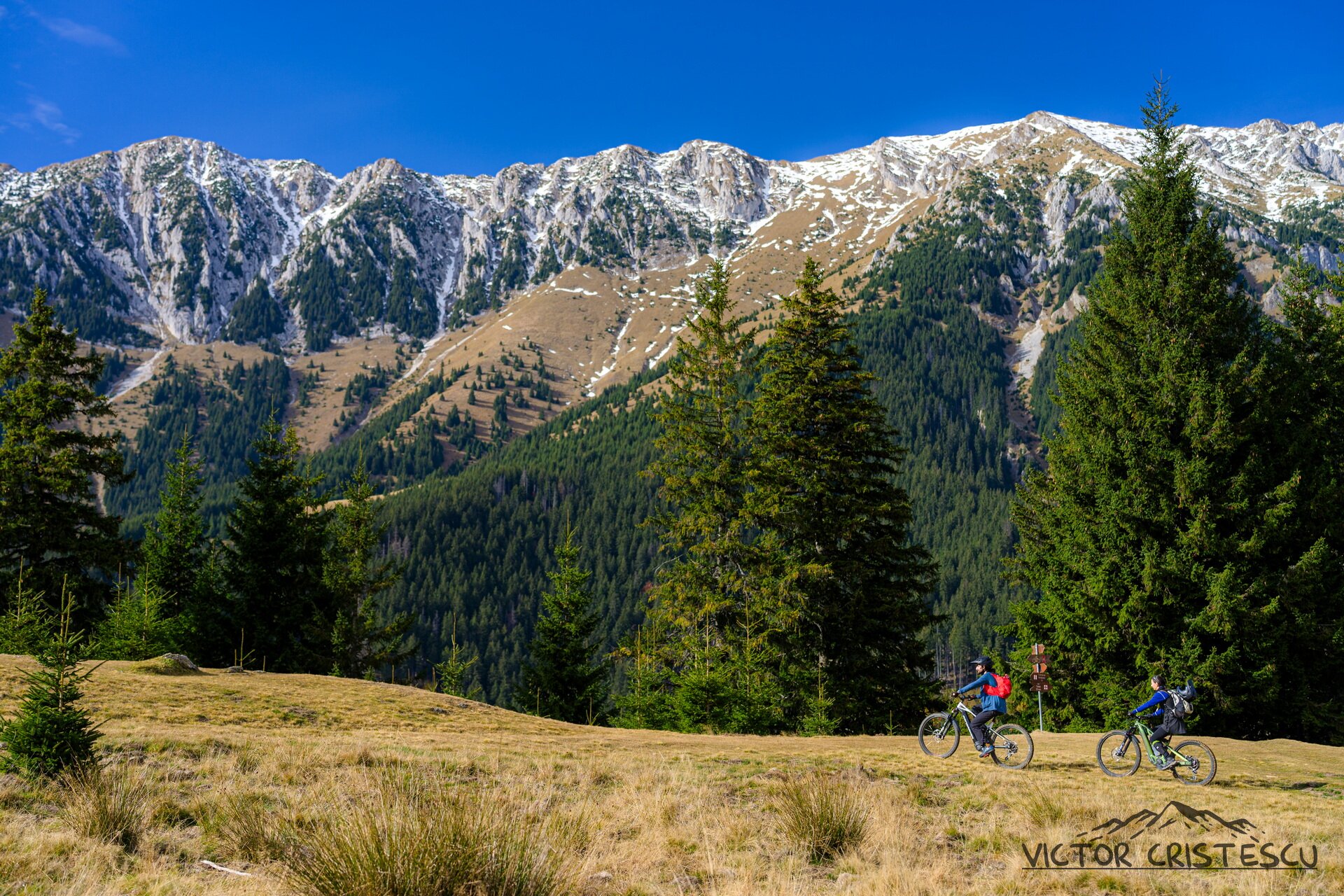
Park entry costs ten lei per adult for three months, sold via SMS, online, or at the Zărnești tourist office. Children under fourteen are free. The Măgura and Peștera ridge between Bucegi and Piatra Craiului is, in my view, one of the most photogenic riding meadows in Romania: working farmhouses with mowed pastures in the foreground, the 25-kilometre limestone ridge as the backdrop.
Făgăraș north, the option for the longer day
The northern accessible side of Făgăraș does not have a marked MTB-park infrastructure comparable to Postăvaru or Piatra Craiului. The riding here is gravel and forestry on the Transylvanian foothills, out of villages like Sâmbăta de Sus, Șinca, and Vad. Long days, big country, fewer trail features, more sky.
The Făgăraș Mountains offer a scale and wild majesty that sets them apart from Piatra Craiului or Bucegi. From the heights, the range unfolds as an endless sea of peaks, rugged and untamed.
Avrig serves as a primary trail hub, hosting the Triada race series. Though these events focus on XC and e-bikes, the routes often lean toward technical enduro terrain. From the Deer Farm near Avrig, the climb to Bârcaciu Cabin is short but demanding, packed with roots, switchbacks, and a newly built section near the top. After recharging with authentic fir-bud syrup at the cabin, riders can ascend through Puha Valley to Şaua Scării. Here stands the Scara Refuge, inaugurated in 2023 as one of the most modern shelters in the Carpathians. Popular descents include Drumul Tunurilor, best ridden in September, or the technical lines back toward Poiana Neamţului.
Another major gateway is Suru Cabin, accessible from Sebeşul de Sus or Avrig. The cabin has seen remarkable investment recently. Reaching the crest from Suru involves at least two hours of hike-a-bike to Chica Pietrelor, followed by an epic descent all the way to Turnu Roşu. This is only a fraction of what the Făgăraş range offers, with other access points like Rudăriţa, Dejani, or Şinca Nouă promising long days, nights in remote refuges, chamois encounters, and breathtaking scenery.
It is simply the majestic nature of these mountains and their endless vastness that enchant me again and again, calling me back. They were the first peaks I ever truly fell in love with, back in 2001, when I began exploring their ridges as a child with my parents. To my young eyes, it felt like entering an entirely different universe, a scale so massive it completely redefined everything I had known before in Postăvaru, Bucegi, or Ceahlău. Făgăraș became my ultimate ‘soul mountain,’ a deep-seated connection that is periodically reconfirmed today from behind the handlebars. Riding the rugged, demanding zones around Bârcaciu and Suru remains some of my absolute favorite experiences on a bike, a poignant reminder that no matter how many trails I ride, these wild peaks will always call me home.
Lifts, getting there, getting around
Brașov-Ghimbav airport (GHV) and the alternatives
GHV opened in June 2023, ten kilometres from the city centre. As of 2026 the carriers are Wizz Air (UK and Malta entities), Animawings, and HiSky, with around twelve destinations across seven countries. Most frequent route: Budapest, around seven flights weekly. Direct service from London Luton, Dortmund, Memmingen, Nuremberg.
Two markets without confirmed direct routes for 2026: Switzerland and the Netherlands. Riders from Zürich, Geneva, Amsterdam or Eindhoven currently route via Budapest or via Bucharest Otopeni.
Bucharest Otopeni (OTP) to Brașov by train remains a strong alternative, sometimes a better one. Direct trains roughly every thirty minutes from București Nord, fastest 2 hours 16 minutes, tickets between 7 and 31 euros. For riders arriving at Otopeni with bike bags, some local guides offer an airport pickup that takes you and your luggage straight to Brașov, which removes the bag-and-bike juggling on public transport. Sibiu (SBZ) is a third option, about 2 hours 17 minutes by car.
Bike rental in Brașov
The rental ecosystem here is real and current; the “no rentals in Romania” myth is addressed in the next section. For trail and all-mountain riding specifically, fleet quality matters more than the number of operators, so the list below is ordered by what I would actually recommend for that kind of riding:
| Operator | Base | Notes |
|---|---|---|
| (via Swissôtel) | Poiana Brașov | Guided tours, certified instructors, premium enduro, e-bikes and DH bikes, mostly Specialized. Top pick. |
| Rentabikebrasov.ro | Poiana Brașov | Premium enduro, e-bikes and DH bikes: Mondraker, Polygon, Evil, Santa Cruz, Amflow, Pivot |
| Rental Bike Brașov | Brașov city | Mostly XC hardtails; fine for lighter rides |
| Bike4rent | Bran | Mondraker enduro e-bikes |
| Carinthia Bike Predeal | Predeal | 25+ Bosch e-bikes, April to October |
(Note: Bikexplore is the same operation as OutdoorFun, so it is listed once. A few other names that circulate online are not currently recommended for all-mountain use, either because their fleets are too dated or because they could not be reached.)
Repair shops
Playbike, PlanetBike, BikeLab on Strada Carpenului 3 (suspension overhauls, wheel builds, drivetrain), BikeServ on Strada Oasului 14 (Shimano dealer), and CUB Bike Shop. Walk-in works on weekday mornings; for suspension internals or complex jobs, call ahead, especially in summer when shops are busy.
What you’ve heard, and what’s actually true
A few claims about riding in Romania circulate online with enough persistence that they shape what visitors expect before they arrive. The receipts.
“There are no bike rentals in Romania”
Demonstrably false in 2026. As the section above documents, Brașov, Poiana Brașov, Predeal, Bran and Zărnești host multiple operators with current full-suspension MTB and Bosch e-MTB inventory. For a capable full-suspension e-bike, expect from around 200 to 250 lei for a 2 to 4 hour rental, up to roughly 370 to 420 lei for a full day. The “no rentals” claim seems to come from older trip reports written for thinner-provision regions or earlier years; for the riding this article describes, it does not apply.
“The trails are unmarked and dangerous”
Piatra Craiului National Park has eleven marked cycling routes with downloadable GPX and a tiered difficulty system. Bike Park Postăvarul has seven lift-served signed gravity trails. Azuga has two marked trails, one for downhill and one for trail riding. Trailforks catalogues over two hundred mountain biking trails in the greater Brașov region. The honest qualification: many of the best natural descents below the bike park, including parts of the Yellow Triangle and the Crucur variants, are not signposted by any administration and live on Trailforks and in local knowledge rather than on official signs. That is exactly why a guide or a local riding partner earns the cost on a first visit, and the reasons go well beyond navigation, as the next point explains.
“Romania is wilderness”
This is the line international cycling press tends to lean on, and it is only half right, which is the interesting part. Romania genuinely is wild in ways most of the Alps no longer are, and that wildness is one of the real reasons riders come. Two things drive it. First, the wildlife: you can meet bears, lynx, chamois, wild boar and more in these mountains, where many Western ranges feel comparatively sterile. Second, a more relaxed legal and access situation means you can still ride many natural hiking trails here. In countries like Austria there are firm separations between hiking paths and purpose-built bike trails, with fines if you stray; here the line is softer, and natural trails keep a charm that will always draw a certain kind of rider. And yet Romania is not untouched wilderness either. The Carpathians are inhabited, working mountains: shepherds move flocks of three to six hundred sheep April through November on transhumance routes their grandparents used, foresters and Romsilva crews are on every accessible road, and the local MTB community has been publishing trail content for over a decade. Both are true at once, living and worked, and wild at the edges. That combination is the draw.
“You need a guide everywhere”
Not everywhere, but a guide adds far more than a GPS track. Self-guidable: the marked Piatra Craiului routes with GPX, Bike Park Postăvarul, and the Tâmpa loop. Where a guide genuinely earns the cost is the Bucegi Plateau Potcoava, a first ride on Postăvaru’s natural singletracks, and multi-day point-to-points across massifs. The deeper value is that a good local, working from an honest read of your skill, knows which trails to put you on and in what order, which access routes to choose, the current state of each trail and which ones hold up in the wet, and the safer evacuation options if something goes wrong. The locals always have the most delicious recipes for trails, matched to your style, your level, and the actual conditions on the network that week. Reputable Brașov-based operators include Massif Experience, mtbtours.ro, OutdoorFun, and Backcountry Romania.
Bears, dogs, and the working mountain
These are working mountains, and the wildlife is part of how they work. Honest framing matters here, because the topic produces both bravado and panic in roughly equal measure online.
Brown bears, what the data actually says
Romania’s 2025 official genetic census, conducted by the Ministry of Environment using more than 24,000 non-invasive DNA samples, put the brown bear population between 10,419 and 12,770 individuals at 95 percent confidence. Roughly forty percent of Europe’s brown bears, excluding Russia.
Be realistic about what this means on the ground around Brașov. From April onwards, bears move a lot, and you will see bear sign, scat on the trail, regularly through the season, on marked and unmarked routes alike. Plenty of riders here see a bear at some point. That is not a reason to panic; it is a reason to carry bear spray as a constant habit, for safety and for peace of mind, and to know how an encounter actually plays out. Often a bear hears or sees you coming and bolts in the opposite direction, especially if you are moving and making noise. Sometimes one is simply unimpressed and does not move. In that case the recommended response is to retreat slowly and deliberately, no sudden movements, in a different direction but without turning your back on it. Speak in a calm, firm voice, do not make direct eye contact, do not run. A whistle is worth carrying in the forest, and if you ride with a partner, keep talking out loud; solo, just sing or think out loud so a bear hears you coming from a distance. Serious encounters remain statistically rare for cyclists on established routes; most recorded incidents involve people off marked trails, foraging in dense terrain, or deliberately approaching or feeding bears.
Salvamont’s official guidance for trail users echoes this: make your presence known, do not run, retreat slowly without turning your back, carry pepper spray, avoid going alone where you can. The full set is on Salvamont Romania’s emergency page.
Shepherd dogs, the under-discussed real risk
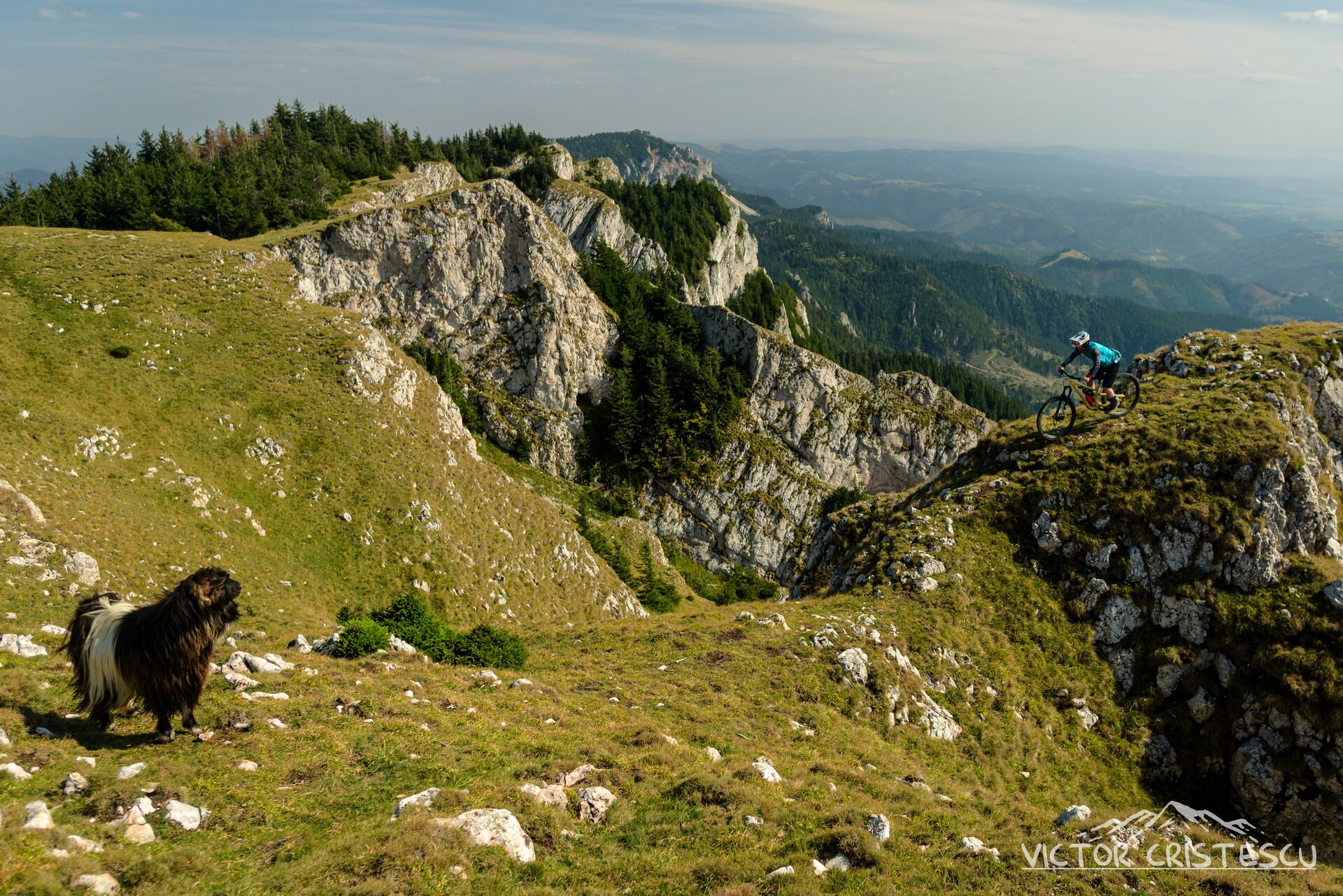
The Romanian Carpathian Shepherd and Mioritic Shepherd are large livestock guardian dogs that work in packs of three to ten around sheepfolds. Thru-hikers consistently describe sheepdog encounters as more frequent and more demanding than bear encounters, and the same applies to cyclists. When you see a flock ahead: dismount before approaching, raise your arms slowly and greet the shepherd from a distance in any language, speak loudly, and do not run, accelerate past, or try to outride the dogs. The situation calms once the shepherd recognises you. Pepper spray works if needed, and a less invasive, often more effective option is a small ultrasonic dog deterrent. Transhumance runs April through November, so this is a daily reality of summer riding in the alpine pastures.
Salvamont and staying reachable
National Salvamont mountain rescue dispatch is +40 725 826 668; general European emergency is 112; Salvamont Brașov is +40 736 628 948. The Bucegi plateau has long-standing dead zones for cellular signal, which is why Salvamont Râșnov was equipped with a satellite phone in 2025. If you are riding the Potcoava or any deeper Bucegi route, download offline maps, carry a power bank, share your live location, and tell someone where you are going. The single most useful piece of kit for remote days is a satellite messenger such as a Garmin inReach Mini 3, which lets you communicate and send an SOS over the Iridium network even with no phone coverage.
Events to time a 2026 trip around
Some riders plan a trip around an event, others avoid them. The 2024 UEC Mountain Bike European Continental Championships were held at Cheile Grădiştei, which establishes the venue’s standing. The 2026 UCI Mountain Bike World Series does not visit Romania, but several strong national and regional events do. Dates and formats shift, so confirm closer to your travel dates.
| Date 2026 | Event | Location | Format / status |
|---|---|---|---|
| 22 August | Transilvania Bike Trails Race (TBT) | Saschiz | XCM marathon, multiple distances |
| 18–20 September | Trans Ciucaș (first edition) | Ciucaș, Cheia area | 3-day adventure-style enduro through Ciucaș. The MTB highlight of the year |
If you want one event to build a trip around, the new Trans Ciucaș in September is the most exciting on the 2026 calendar for adventure-minded enduro riders, three days of real backcountry riding through Ciucaș.
Earlier in the season, the annual fixtures worth knowing for a future trip are the Brașov Marathon in late May, a trail running weekend whose routes overlap with the bike trails, Carpathia Trails at Cheile Grădiștei in early July, and the Red Mountain Enduro national round at Cheia at the turn of August. The Up to Postăvaru festival did not run in 2026, but Poiana Brașov still hosted the Balkan Downhill Championship and a national downhill cup round in late July. A four-day Trans Carpathia Enduro stage race is expected to join the calendar, likely from 2027; confirm before planning around it.
For the photographer’s eye
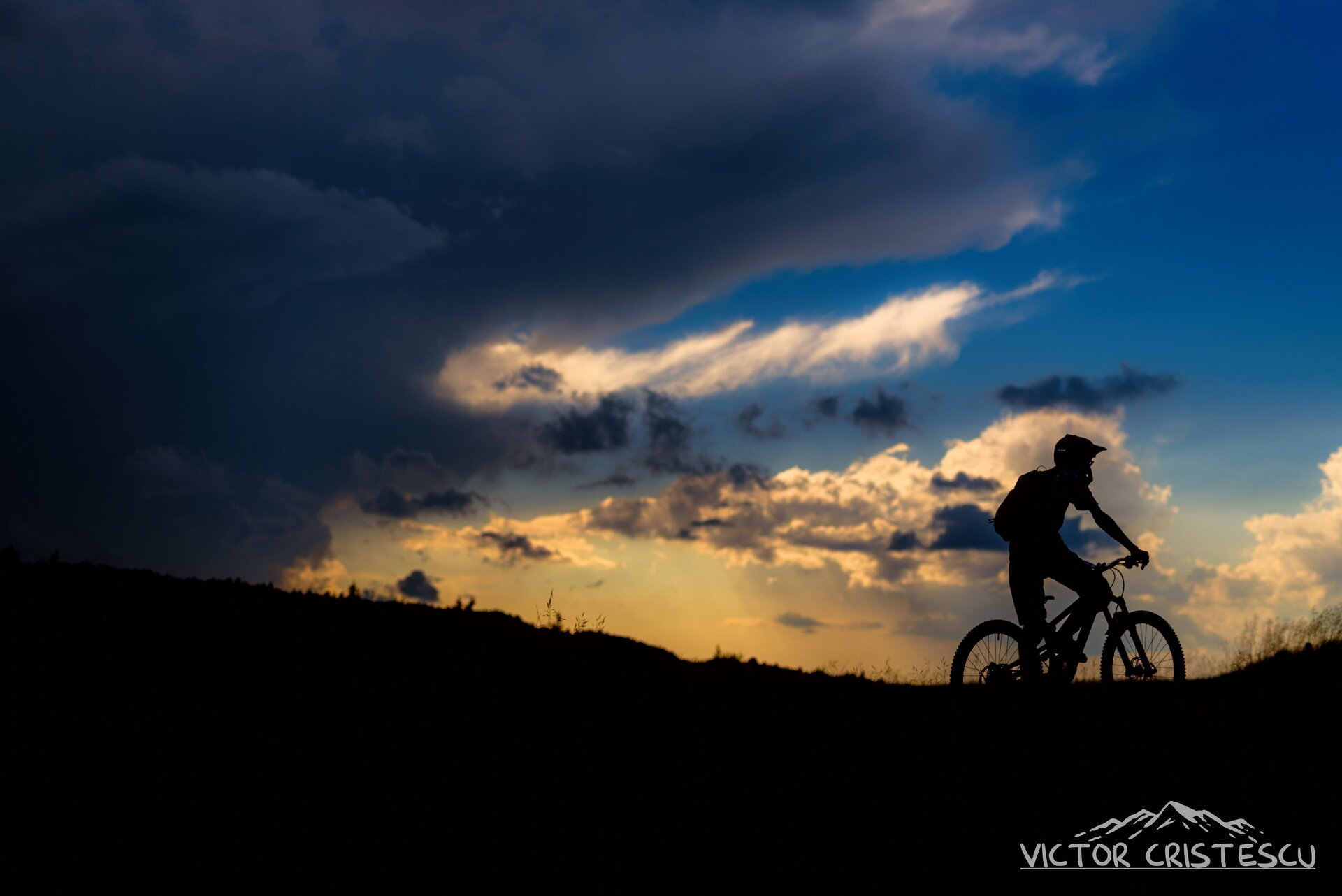
If you ride and you also shoot, the same descents become two activities. The light is part of the route. The angle is part of the line. What follows is what I look for around Brașov.
The east-facing Bucegi escarpment lights up first in the morning. From the Bușteni cable car line in June or early July, sunrise gives you fifteen minutes of cold golden light on the limestone walls before the valley fog burns off. The west-facing lines are the opposite story. Crucur ridge, Poteca Sasului, the lower Yellow Triangle into Brașov: afternoon-into-evening descents, and the last hour of light in September is rare. The valley fog over Brașov from Tâmpa or the upper Postăvaru ridge is an autumn phenomenon, most consistent in late September and through October.
Around Brașov, the highest point is a literal watchtower. From just below the Postăvaru summit at 1,799 metres, a 360-degree panorama reveals Piatra Craiului and Bucegi, alongside Leaota, Piatra Mare, Ciucaș, Baiului, Perșani, Baraolt, and Bodoc.
Finding the best light often means changing pace. Stejerișul Mare peak is a rewarding “easter egg” tucked away after the technical rock garden on the Yellow Triangle. After a sharp left and a short, demanding climb you reach a quiet belvedere, ideal for watching the sunset over Măgura Codlei. Back on the Yellow Triangle, the shorter exit toward Coasta Prundului opens up the city of Brașov in all its glory; this spot sits next to one of the many ancient wayside shrines, locally known as troițe (this one dating to 1711). The descent from this belvedere features a significant rock face that needs careful line choice, with an alternate line on the left that must be spotted early. In spring, the Păstăi track offers a different kind of eye candy: just before the steep section, warm sunset light hits the fresh green, and through the branches you can see snow still clinging to the Postăvaru massif.
For the most epic sunrise and sunset sessions, staying overnight at high-altitude hubs is the ultimate strategy. Curmătura cabin in Piatra Craiului, Refugiul Șaua Strunga in Bucegi, or the modern Refugiul Scara in Făgăraș make perfect bases. They are also gateways to legendary descents, like the long technical run from Scara down to Cabana Bârcaciu and Poiana Neamțului. These are the places worth carrying the camera for.
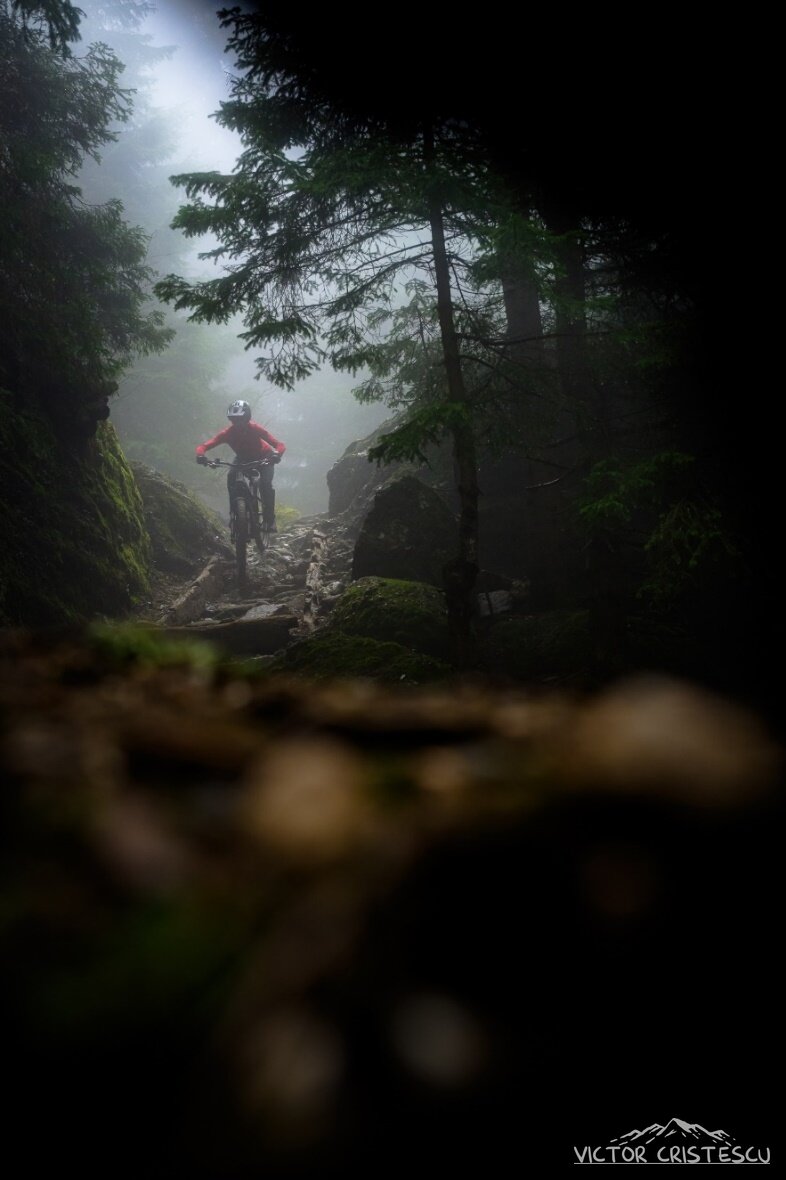
This particular shot perfectly captures this intersection of riding and shooting. It is from a scouting mission a few days before the Transylvania 100k trail running contest, when Sebi and I rode our e-bikes up to Mălăiești cabin and then hiked toward the Țigănești refuge. I was looking for photo spots and checking the high alpine snowpack. Though the image depicts a descent, it was actually taken while we were sessioning the section on the climb, fooling around with lines up and down, knowing the forecasted afternoon rain might rush us back down later, leaving no time for photography.
The conditions were my favorite for shooting: rainy, overcast, with a thick layer of mist in the mix: not the best for riding, but surely delightful for the camera. I love how Sebi’s silhouette emerges from that white void, balancing the rich greens of the moss against his red gear. We dialed it in so you can recognize features and colors, yet his face remains just obscured enough to keep that moody, mysterious vibe.
Ironically, these weather conditions turned out to be friendly compared to the race itself, which was plagued by genuinely foul weather, terrible visibility, and degrading grip in the high alpine snow patches. But in that quiet moment, the mountain offered up exactly the drama I was looking for.
Frequently asked questions
When is the best time to ride MTB in Brașov?
Mid-May through October. September is the sweet spot for stable weather, dry trails, autumn light, and the lowest summer crowds, and mid-to-late October catches peak fall colours. June is the wettest month, with around 125 millimetres of rain. Conditions vary year to year, so check before a ride.
Can I rent a mountain bike in Brașov?
Yes, easily. Brașov, Poiana Brașov, Predeal, Bran and Zărnești host several rental operators in 2026, including premium enduro and Bosch e-MTB fleets. For a capable full-suspension e-bike, expect from around 200 to 250 lei for a few hours up to roughly 370 to 420 lei for a full day.
Do I need a guide?
Not for marked routes. The Piatra Craiului network with GPX, Bike Park Postăvarul, and the Tâmpa loop are self-guidable. A guide is worth it for the Bucegi Plateau, for a first ride on Postăvaru’s natural singletracks, and for multi-day point-to-points, both for safety and because a local knows which trails suit your level and the current conditions.
What about bears?
A real consideration, but manageable. The 2025 census put the population at ten to thirteen thousand. From spring on you will see bear sign regularly, and many riders see a bear at some point. Stay aware, do not run, retreat slowly without eye contact, carry pepper spray, and make noise as you ride.
How hard are the trails around Brașov?
The range goes from green to double-black. Genuinely beginner-friendly options are limited: parts of the Iepure singletrack, Poteca Fetelor, Drumul Domnilor and Strătilă’s trail are a few worth mentioning. Forest Flow and Killy’s Back Yard in Bike Park Postăvarul are blue, intermediate rather than beginner.The NH DH race line, Westreme, and the Crucur, Jackie, Moto and Sasului variants are for experienced riders. Trailforks catalogues over two hundred trails; you will find your level.
What’s the bike-friendly way to reach Brașov?
GHV opened in 2023 and runs direct flights from London Luton, Dortmund, Memmingen, Nuremberg, and Budapest, among twelve destinations. Bucharest Otopeni is a strong alternative, with direct trains to Brașov in 2 hours 16 minutes for around fifteen euros, and some local guides will collect you and your luggage from the airport.
Can I bring my bike on the cable cars?
Yes, on whichever installations are running. In Poiana Brașov bikes go up by gondola, cable car and chairlift with separate rider-plus-bike ticketing, 55 lei a single trip and 180 lei for a day pass in 2026. The Postăvarul Express gondola is back in service after maintenance earlier in the season and takes bikes. The Bușteni cable car onto the Bucegi plateau accepts bikes but expect long queues in summer peak, so a private shuttle is often the better option in July and August.
Coming to ride
I learned these mountains on foot first. The bike came later, and the camera came with it. What I want to say at the close of a long article is small. The Carpathians are working mountains, inhabited and walked and ridden, and wild at the edges, and they reward the rider who comes for what they actually are rather than what a brochure says. The September window is short. The events fill. The good rentals book up. Plan early.
If you’re planning a ride here and want it documented properly, I’d be glad to shoot it. The sport- and location-specific portfolio is at /portofoliu/, and you can reach me through /contact/.